


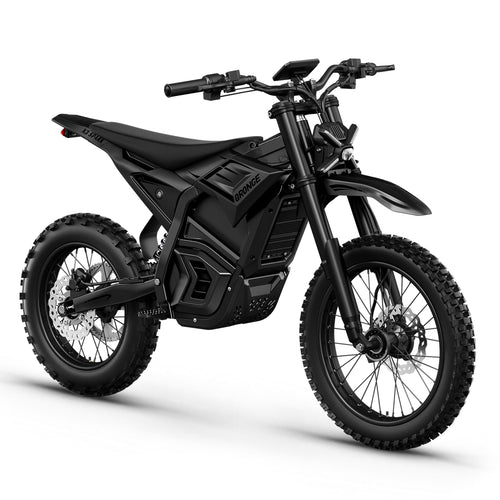
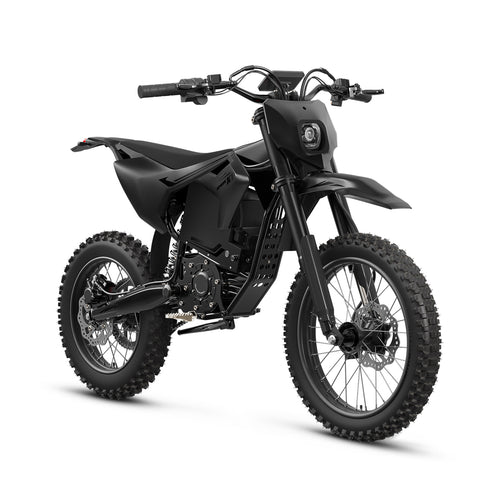
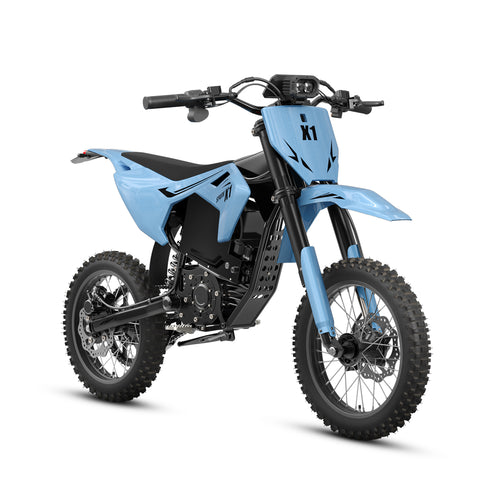



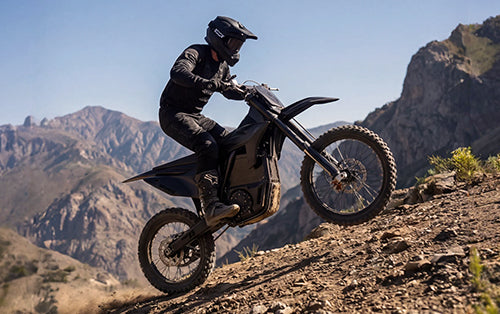



At first glance, 17/14 and 19/16 wheel setups differ by only two inches at both the front and rear. But once you get onto the trail, that difference directly affects how the bike turns, how it rolls over obstacles, and how the rider needs to approach the terrain.
If the trail is narrow, full of tight turns, and requires frequent direction changes, a 17/14 setup is easier to pair with a compact, agile electric motorcycle platform. If the trail is more open, with more rocks, roots, deep ruts, and repeated uneven sections, the larger 19/16 wheels are better suited to rolling over obstacles and maintaining a steady forward riding rhythm.
So, when choosing between 17/14 and 19/16, the key question is not which size is larger, but whether your usual riding involves more line changes or more direct obstacle crossings.
What Do 17/14 and 19/16 Actually Change?
17/14 means a 17-inch front wheel and a 14-inch rear wheel, while 19/16 means a 19-inch front wheel and a 16-inch rear wheel.
Dirt bikes use a larger front wheel than a rear wheel because the two wheels serve different roles while riding. The front wheel meets rocks, roots, holes, and ruts first while also handling steering; the rear wheel needs to roll over terrain while delivering power and maintaining traction.
So, when the front wheel increases from 17 inches to 19 inches, the most immediate difference appears when the front wheel meets an obstacle.
If a 17-inch and a 19-inch front wheel hit the same size rock, the obstacle is smaller relative to the radius of the 19-inch wheel, and the wheel approaches it at a shallower angle. This does not eliminate the impact, but it allows the wheel to roll forward over the obstacle more easily.
The difference may not be obvious on smooth, hard-packed trails. But once the trail includes repeated roots, loose rocks, holes, and deep ruts, the advantage of the larger wheel becomes more noticeable.
A 17/14 setup keeps a different advantage. Smaller wheels are easier to pair with a compact bike platform. On trails that require repeated turns, low-speed corrections, and frequent line changes, riders can focus more on “where to go next” rather than relying on larger wheels to roll over obstacles.
Of course, wheel size alone does not determine handling. Wheelbase, overall weight, front-end geometry, suspension, and the tires themselves all affect how the bike feels. Wheel size mainly influences the direction the bike is more likely to take:
17/14 leans more toward a compact setup and line control, while 19/16 leans more toward obstacle rollover and maintaining forward momentum.
17/14 vs 19/16 Model Specifications
Current electric motorcycles using these two-wheel setups cover different power levels and bike platforms. The models below provide examples of how 17/14 and 19/16 setups are used in practice.
|
Model |
Wheel Setup |
Peak Power |
Torque |
Battery |
Top Speed |
Range |
Weight |
|
Qronge X1 Spark L |
17/14 |
4,500W |
283 Nm |
60V 28.8Ah |
50 mph |
60 mi |
146 lb |
|
Yozma IN 10 Pro |
17/14 |
5,500W |
220 Nm |
60V 27Ah |
50 mph |
60 mi |
143 lb |
|
Eskute NOVA Beast |
17/14 |
5,500W |
250 Nm |
60V 27Ah |
35–50 mph |
60 mi |
123.51 lb |
|
Arctic Leopard XF |
17/14 |
12,000W |
342 Nm |
72V 35Ah |
45 mph |
40 mi |
130 lb |
|
Qronge X5 Spark |
19/16 |
6,000W |
300 Nm |
60V 50Ah |
65 mph |
110 mi |
238 lb |
|
Qronge X7 Spark |
19/16 |
12,000W |
600 Nm |
72V 50Ah |
70 mph |
120 mi |
246 lb |
|
Arctic Leopard XE Pro S |
19/16 |
20,000W |
600 Nm |
74V 60Ah |
62 mph |
50 mi |
161 lb |
The Advantage of 17/14 Is More Noticeable on Trails That Require Frequent Direction Changes
Some trails are difficult not because the obstacles are large, but because riders have very little space to manage their line.
You may have just gone around a rock, only to reach a tight turn a few yards later. A rut appears on the right, so the front wheel needs to move back to the left. After crossing a root, you may need to immediately reposition for the next turn.
On this type of trail, the rider is constantly doing the same thing: deciding where the front wheel should go next.
A 17/14 setup works well with this kind of riding rhythm.
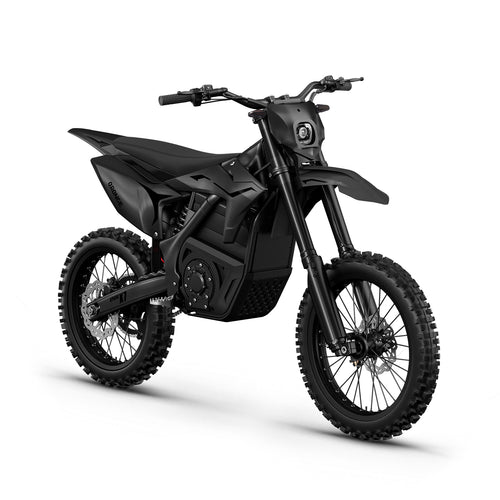
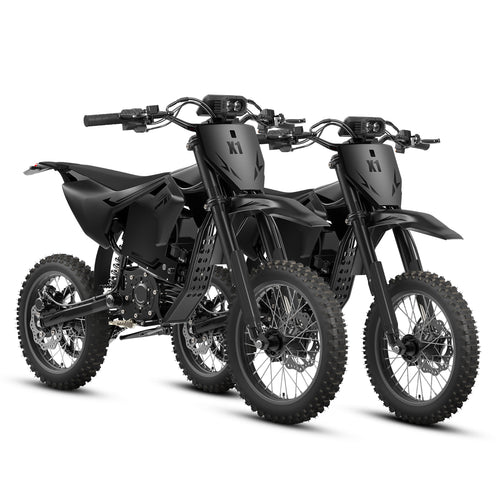
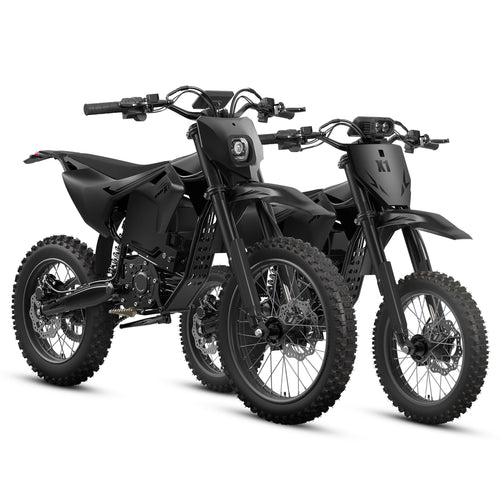
The Qronge X1 Spark L uses a 17/14 wheel setup, weighs 146 lb, and has a 45-inch wheelbase. The Yozma IN 10 Pro also uses 17/14 wheels, weighs 143 lb, and has a 114 cm wheelbase, or about 44.9 inches.
The two models have different power setups, but both use 17/14 wheels on relatively compact platforms. The Eskute NOVA Beast also uses 17/14 wheels and weighs about 123.5 lb. The Arctic Leopard XF still uses 17/14 wheels despite its 12 kW peak power, along with a 47-inch wheelbase and a weight of 130 lb.
This also shows that 17/14 is not limited to any one power level. What matters more is how this wheel size works with the bike’s overall proportions and handling direction.
For example, on a narrow trail, a rider does not always need to ride directly over a rock. If there is room on the left, the front wheel can be redirected before reaching it. A deep rut can also be avoided by changing lines before entering it. Through a series of turns, accurately placing the front wheel on the next line is often more important than having the largest front wheel.
So, if the trails you ride most often have tight turns, limited space, frequent speed changes, and obstacles that can usually be handled by choosing a different line, a 17/14 setup is generally better suited to that riding style.
Its advantage is not simply that it is “smaller,” but that it is better suited to a riding rhythm that requires active line control.

The Value of 19/16 Becomes More Noticeable as the Terrain Gets Rougher
On a different type of trail, the advantages of 17/14 are no longer the only priority.
As the trail opens up and speeds increase, riders may encounter repeated cross-trail roots, larger rocks, deep ruts, and holes, with little room on either side to go around them. At that point, the question changes from:
“Where should I go through?”
to:
“How do I keep the bike stable through this section?”
This is where a 19/16 setup starts to show its value.
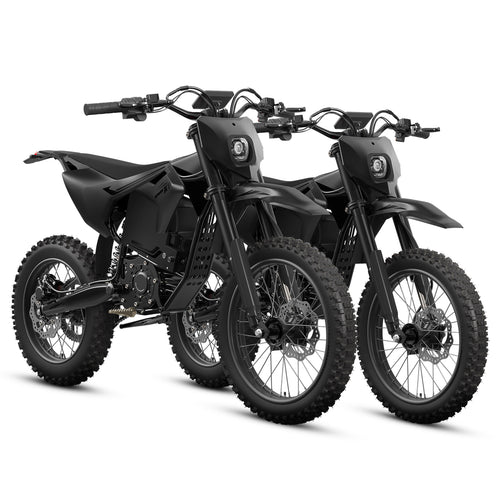
The Qronge X5 and X7 both use 19×2.8-inch front tires and 16×3.5-inch rear tires. Compared with the 17/14 setup on the X1 Spark L, the larger 19-inch front wheel meets a root or rock of the same height at a more favorable angle.
The difference becomes especially noticeable on repeated rough terrain.
Imagine a section that starts with a cross-trail root, immediately drops into a hole, and then leads into a rut. The rider has almost no time to choose a new line between each obstacle. In this situation, the advantage of the larger wheel is not that one impact suddenly feels much lighter, but that the front wheel can more easily keep rolling forward as it passes over one obstacle after another.
The Arctic Leopard XE Pro S is another 19/16 example. It uses a 70/100-19 front tire and a 90/100-16 rear tire, along with a 51.2-inch wheelbase.
Its weight and power setup are different from the Qronge X5 and X7, but all three models reflect a common use for 19/16: when riding demands shift toward larger obstacles, more continuous rough terrain, and a steadier forward pace, larger wheels become more meaningful.
So, 19/16 is not simply a larger, “higher-level” version of 17/14.
It solves a different problem.
17/14 is better suited to letting the rider actively change lines, while 19/16 is better suited to keeping the wheels moving through the terrain when the line is already set and obstacles are difficult to avoid.
17/14 or 19/16? Start With the Hardest Part of the Trail
If a trail includes tight turns, rocks, and ruts, simply saying “I ride trails” is still not enough to decide which wheel setup is right.
A more useful approach is to think about what most often interrupts your riding rhythm.
If the bike often feels difficult to control through repeated turns, narrow sections, and low-speed line changes, or if you frequently need to go around obstacles and find a new entry line, a 17/14 platform should be the first option to consider. The Qronge X1 Spark L, Yozma IN 10 Pro, Eskute NOVA Beast, and Arctic Leopard XF are examples of different power setups using this wheel size.
If larger rocks, cross-trail roots, deep ruts, and repeated holes that are difficult to avoid are what make the trail challenging, then 19/16 is worth more consideration. The Qronge X5, X7, and Arctic Leopard XE Pro S offer 19/16 options at different performance levels.
Once the wheel setup is decided, the next step is to compare specific models.
At that point, the focus shifts to whether the seat height feels natural, whether the bike’s weight is easy to manage, whether the wheelbase fits your riding style, whether the suspension can handle the terrain you ride most often, and whether the front and rear tire widths and tread patterns match the surface.
For example, the Qronge X1 Spark L and Eskute NOVA Beast both use 17/14 wheels, but the former uses 17×2.8/14×3.5-inch tires, while the latter uses 17×3.0/14×3.0-inch tires. The same wheel-size label does not mean the two bikes have exactly the same tire characteristics.
So the selection process is straightforward:
Use the terrain to decide between 17/14 and 19/16 first, then compare the full bike specifications within that wheel setup.
That way, wheel size becomes a practical selection tool rather than just an isolated number in a specification table.
Further Reading: If you have already identified your main off-road riding conditions and want to compare different models, continue with “Best Electric Dirt Bikes for Off-Road Riding in 2026.”
17/14 and 19/16 Are Two Different Off-Road Trade-Offs
17/14 and 19/16 are not two different performance levels.
A 17/14 setup leaves more room for a compact bike platform and line control, making it better suited to riding that requires frequent turns, position changes, and actively finding a way through the trail. A 19/16 setup uses larger wheels to improve how the bike handles rocks, roots, deep ruts, and repeated uneven terrain, making it better suited to holding a line and continuing through rough sections.
Once the wheel setup is chosen, comparing weight, seat height, wheelbase, suspension, and tire specifications is the next step in choosing a specific electric motorcycle.
The right wheel setup is not the one with the biggest numbers, but the one that best matches the terrain you ride most often and the way you handle the trail.


