





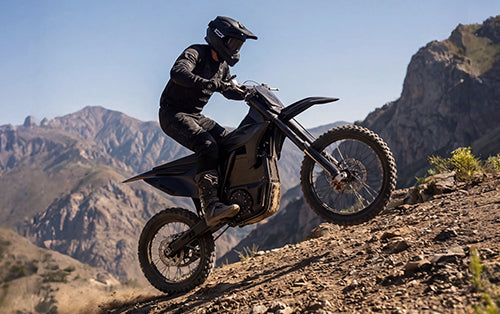



Why does the battery on the same electric dirt bike seem to last longer at lower speeds, but the range drops noticeably when riding faster? The main reason is that higher speeds create more air resistance, requiring more energy to maintain that speed.
For an electric dirt bike, the relationship between speed and energy consumption is not simply linear. Air resistance increases more rapidly at higher speeds. Continuous climbs, soft terrain, or frequent acceleration can further increase battery consumption.
As a result, the range does not mean the bike can travel the same distance at every speed. Understanding how speed, air resistance, and off-road conditions affect range helps riders plan their routes more effectively and determine which power and battery configurations best suit their needs.
Why Does Riding Faster Drain an Electric Dirt Bike Battery More Quickly?
While riding, an electric dirt bike must overcome air resistance, tire rolling resistance, and additional loads caused by the terrain. As speed increases, these forces affect energy consumption differently. Air resistance, in particular, is a major reason why range drops significantly at higher speeds.
Air Resistance Increases Rapidly With Speed
As an electric dirt bike moves, it must constantly overcome the air resistance pushing against it. The faster it travels, the greater this resistance becomes.
Under conditions with no wind, and assuming the bike's frontal area and the rider's position remain unchanged, air resistance is approximately proportional to the square of speed, while the power required to overcome it is approximately proportional to the cube of speed.
For example, when an electric dirt bike increases its speed from 20 mph to 40 mph, its speed doubles, but air resistance increases to approximately four times its original level. The power needed to overcome that resistance increases to approximately eight times its original level.
Of course, this does not mean the electric dirt bike's total energy consumption also increases eightfold. The battery must also supply energy to overcome other riding forces. However, this relationship explains why riding at higher speeds often has a greater impact on range than expected.
Sustained High-Speed Riding Increases Battery Load
Beyond air resistance, maintaining higher speeds generally requires the motor to deliver more power continuously.
Under these conditions, the battery must supply more electrical energy. Higher current demand can also increase energy losses within the battery, controller, and motor. During sustained high-speed riding, some energy is also lost as heat.
This effect is especially important when maintaining high throttle output for extended periods. If the battery charge is already low or the system temperature is high, the battery management system or controller may limit the electric dirt bike's power output.
As a result, riding at higher speeds not only drains the battery faster but may also affect the electric dirt bike's ability to maintain continuous power output. However, the extent of these effects depends on the bike's configuration and actual operating conditions.
How Much Does Riding at 20, 30, or 40 MPH Affect Range?
For the same electric dirt bike, actual range can vary significantly at 20 mph, 30 mph, and 40 mph. However, speed alone cannot accurately determine how many miles the bike can travel under each condition.
This is because actual range is also affected by battery capacity, rider weight, tire condition, terrain, and acceleration habits. Even at the same speed, battery consumption can be very different when riding on smooth trails compared to soft sand.
However, the effect of speed on air resistance can be clearly illustrated using a simplified physics model.
How Speed Affects Air Resistance
Based on 20 mph, assuming no wind and constant air density, drag coefficient, and frontal area. These figures show aerodynamic changes only, not total energy consumption or actual range reduction.
The calculation results are for educational purposes only and do not represent actual Qronge electric dirt bike test data or riding range.
As the model shows, air resistance and the power required to overcome it increase at an accelerating rate as speed rises. This means that at higher speeds, the electric dirt bike needs more electrical energy to overcome air resistance.
However, the rate at which aerodynamic power demand increases is not the same as the rate at which range decreases. Therefore, this model cannot be used to conclude that an electric dirt bike traveling at 40 mph will have only half the range it would at 20 mph.
For actual riding, the most useful reference is how the same model performs under similar terrain, load, and riding conditions, rather than predicting range based solely on top speed.
Why Does Off-Road Riding Consume More Battery Than Steady Cruising?
Beyond speed, off-road terrain can also significantly affect an electric dirt bike's actual range. On hills, sand, and muddy trails, the bike may consume more energy even at lower speeds.
When riding at a steady speed on smooth, firm trails, the motor load remains relatively stable, making energy consumption easier to predict. However, on continuous uphill sections, the bike needs additional energy to overcome gravity. In soft sand, the tires can sink into the surface, increasing rolling resistance and placing a greater load on the motor.
On challenging trails that require frequent acceleration and deceleration, riders repeatedly use energy to bring the bike back up to speed. If the rear wheel frequently loses traction and spins, some of that power is not effectively converted into forward movement.
As a result, two off-road rides with similar average speeds can leave significantly different amounts of battery charge remaining. This is why the range achieved on flat terrain cannot be directly applied to more challenging off-road conditions.
Related Reading: Why Does My Electric Dirt Bike Lose Power at 20%–30% Battery? | Learn more about the relationship between battery voltage, remaining charge, and riding under heavy loads.
Can ECO Mode Really Extend Electric Dirt Bike Range?
ECO mode typically adjusts power output and throttle response to help riders avoid unnecessary hard acceleration and high-speed riding, making it more effective at extending range in real-world conditions.
In comparison, Sport and Turbo modes generally provide stronger power response, making them suitable for off-road conditions that require greater acceleration or power output. However, maintaining high throttle input or riding at higher speeds for extended periods can significantly increase battery consumption.
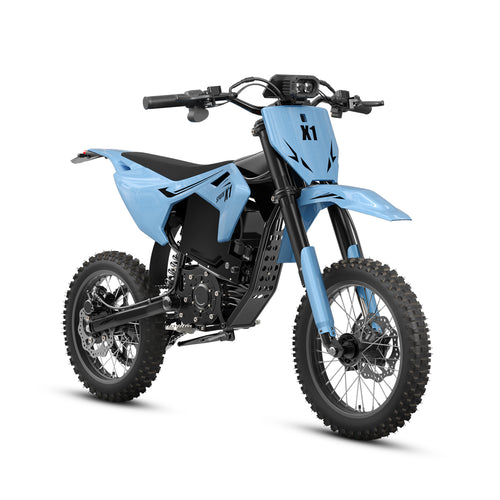
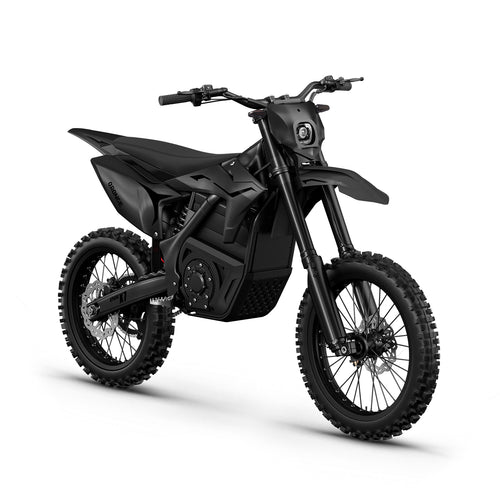
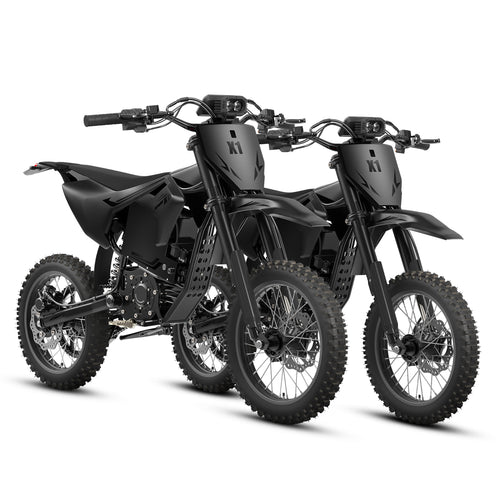
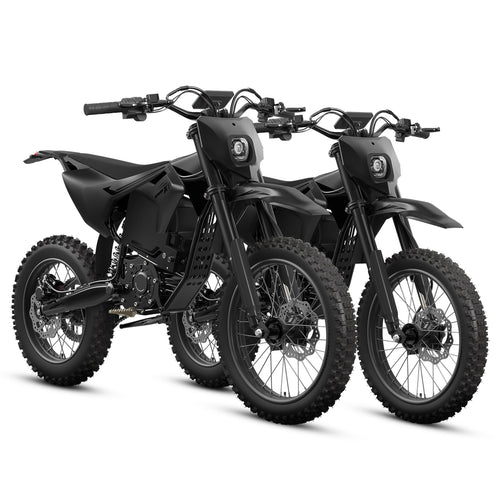
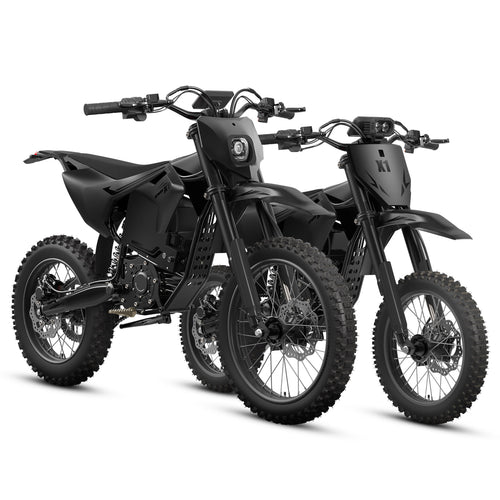
Take the Qronge X1 Spark L, for example. It features a 4500W peak mid-drive motor, a 60V 28.8Ah battery, and three riding modes: ECO, Sport, and Turbo. ECO mode focuses on gentler power delivery, Sport mode provides stronger power response, and Turbo mode is suited for off-road sections that require higher power output. Riders can select the appropriate mode based on terrain and riding distance.
However, switching to ECO mode does not mean the battery will automatically save a fixed percentage of energy. Actual range still depends on riding speed, acceleration habits, and terrain. If speed and power demand remain similar across different modes, the difference in battery consumption may be smaller than expected.
For long-distance trail riding, a more practical approach is to use smoother power delivery on regular trails and adjust riding modes as needed for continuous climbs or challenging terrain. This helps maintain the necessary power response while avoiding unnecessary battery consumption.
X1-L
How Can You Maintain Good Range Without Sacrificing Off-Road Performance?
Getting more range from an electric dirt bike doesn't mean you have to ride at low speeds all the time. A more effective approach is to adjust your riding pace based on trail conditions and avoid unnecessary hard acceleration and braking on sections where you can maintain a steady speed.
For example, if you open the throttle aggressively after every turn and then brake hard before the next one, you repeatedly use energy to accelerate. In comparison, controlling the throttle smoothly and maintaining a consistent riding rhythm generally helps balance power delivery and range.
On hills, sandy trails, or muddy sections, tire traction also matters. If you keep increasing the throttle while the rear wheel spins, the extra power isn't effectively converted into forward movement and may drain the battery faster.
Tire pressure also affects rolling resistance and handling. Before riding, check tire pressure according to the recommended range for the bike and tires, and adjust it appropriately for the terrain rather than simply aiming for higher or lower pressure.
For longer off-road rides, planning your battery reserve for the return trip is just as important. If the return route includes more uphill sections or challenging terrain, leave more battery reserve than you would for a typical flat route to avoid sustained high-load riding when the battery is already low.
Related Reading: What Tire Pressure Should an Electric Dirt Bike Use? PSI Guide for Different Terrain | Learn how to choose tire pressure for different terrain and how tire conditions affect riding performance.
How Should You Balance Speed and Range When Choosing an Electric Dirt Bike?
When choosing an electric dirt bike, you shouldn't focus only on top speed or rated range. What's more important is whether the bike can cover your actual route at your usual riding speed. Riders who frequently ride at higher speeds or explore challenging terrain should also account for the additional battery consumption these conditions may cause.
Battery capacity is an important factor to consider. For example, a 60V 28.8Ah battery has a nominal energy capacity of approximately 1,728Wh, while a 60V 50Ah battery provides approximately 3,000Wh. The latter stores more energy and is generally better suited for longer rides. However, actual range still depends on bike weight, riding speed, terrain, and motor efficiency, and does not increase in direct proportion to battery capacity.
Therefore, before choosing an electric dirt bike, consider your usual routes, riding distance, and power needs, then compare battery capacity and bike performance. For long-distance trail rides or routes with frequent climbs, leave enough battery reserve for the return trip rather than treating the maximum rated range as the distance you can actually travel.
Finding the Right Balance Between Speed and Range
The faster an electric dirt bike travels, the more significantly its range tends to decrease. This is mainly because air resistance increases rapidly with speed, requiring more energy to maintain higher speeds. Challenging terrain, frequent acceleration, and heavier loads can further increase battery consumption.
For riders, managing speed effectively doesn't mean sacrificing power. It means choosing the right riding pace based on terrain and route conditions. When buying an electric dirt bike, riders should also consider their actual riding distance, battery capacity, and power needs rather than focusing only on maximum range or top speed.


