


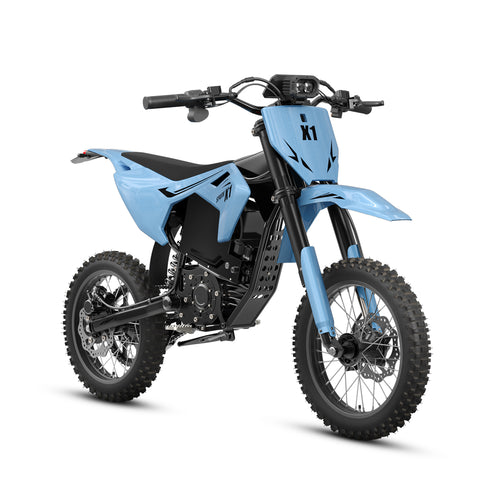
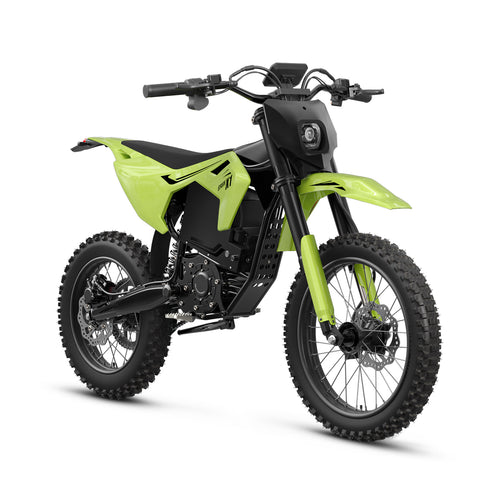

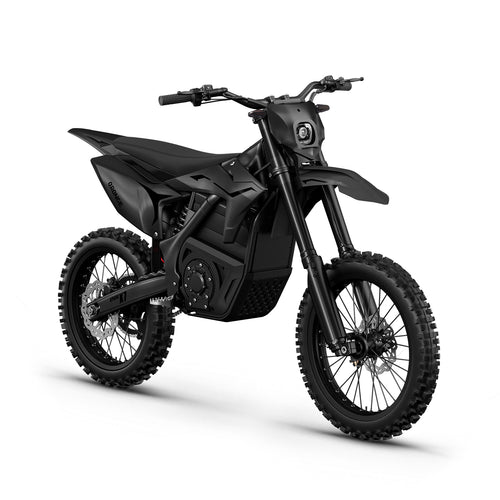
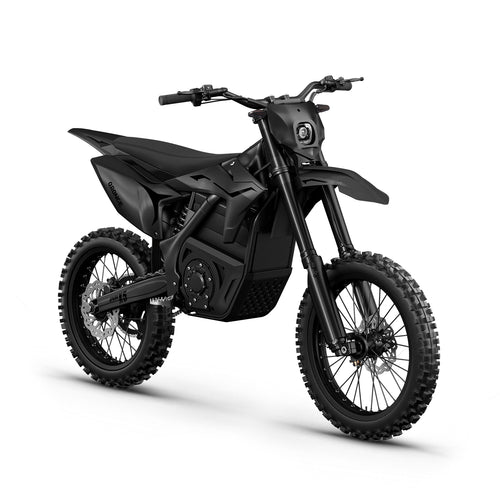


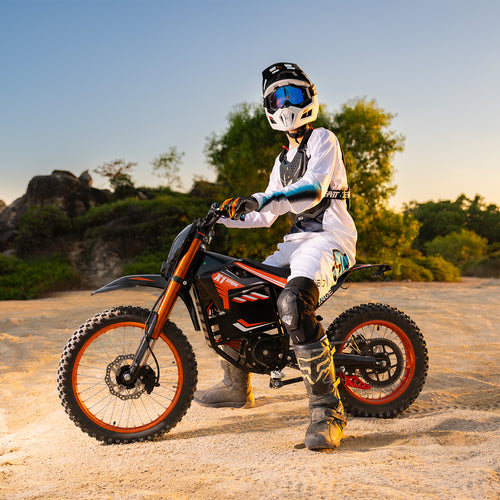
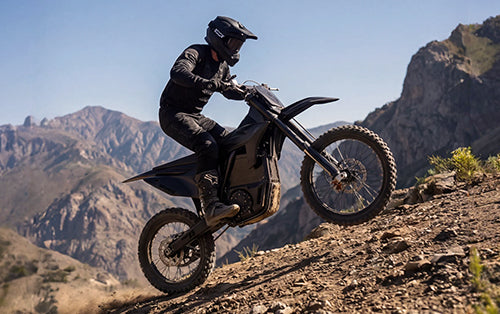



When people compare a 4500W vs. a 6000W electric dirt bike, what they usually care about first is not just the number itself, but more practical questions: how much the top speed differs, how the acceleration feels, whether the battery and range also change, and whether the overall riding experience is really in a different class.
Based on how products are commonly positioned in today’s market, the difference between 4500W and 6000W usually goes beyond a 1500W peak power gap. It often extends further into top speed, mph performance, power reserve, battery size, range, and overall platform completeness.
Many 4500W peak platforms already deliver a clear sense of performance and direct control feedback, and they are commonly found in high-performance entry-to-intermediate models that feel lighter, more compact, and easier to handle. In comparison, 6000W peak platforms are more often used to support higher speed potential, larger battery setups, stronger range performance, and a more complete high-performance package.
That said, this does not mean every 4500W model will reach the same speed, or that every 6000W model will naturally come with the same range or tire setup. For an electric dirt bike, peak power is only one part of the performance picture. What really shapes the riding experience is the combination of power, voltage, battery, controller tuning, tire size, vehicle weight, and overall setup.
That is why the real difference between 4500W and 6000W cannot simply be summed up as “which one is faster.” A more accurate way to understand it is to look at what kind of performance character and riding direction each power level usually represents.
🧭 What 4500W and 6000W Usually Mean in the Market
Looking at common electric dirt bike product logic on the market today, a 4500W peak platform is no longer considered low power. It is usually capable of delivering clear acceleration, direct throttle response, and enough torque for everyday riding and light-to-moderate off-road use. Many models in this category place greater emphasis on light handling, agility, and ease of control, which is why their frame size, wheel setup, and overall tuning often favor a more compact design.
A 6000W peak platform, on the other hand, usually means the bike is moving into a more complete high-performance category. Compared with 4500W, it more often brings a higher top speed, more continuous power delivery, stronger mid-to-high-speed acceleration, and better sustained output. At the same time, bikes in this range are also more likely to come with larger batteries, more mature frame specifications, and more complete wheel setups. So the upgrade is not just about a bigger number. It is about the platform feeling more complete overall.
In other words, the difference between 4500W and 6000W is usually not just a simple matter of one being stronger than the other. It is more like two different ways of expressing high performance: one leans more toward light, direct responsiveness, while the other leans more toward completeness and stronger output.
📊 4500W vs 6000W Electric Dirt Bike: A Quick Comparison
To better understand the common differences between these two power levels, it helps to look at a few key areas first:
|
Comparison Area |
4500W Peak Electric Dirt Bike |
6000W Peak Electric Dirt Bike |
|
Market Positioning |
High-performance entry to intermediate |
More complete high-performance platform |
|
Typical Riding Feel |
Light, direct, agile |
Stronger drive, higher ceiling, more composed |
|
Speed Performance |
Already clearly performance-oriented |
More likely to create a noticeable top speed gap |
|
Power Reserve |
Enough for most common riding situations |
Better suited for higher-intensity riding needs |
|
Battery Setup |
Commonly mid-size to large capacity |
More often paired with larger batteries |
|
Range Logic |
Balances performance and agility |
More focused on improving performance and range together |
|
Overall Character |
Compact, agile, direct feedback |
More complete, more stable, more platform-oriented |
|
Best For |
Riders who value control and a lighter feel |
Riders who want higher limits and stronger reserves |
This table is not meant to define every product in absolute terms. It is simply a summary of the most common product logic behind these two peak power levels. When it comes to actual models, performance and configuration can still vary depending on the brand and the full vehicle platform.
🔥 The Difference Between 4500W and 6000W Is More Than Just 1500W
When many people see 4500W and 6000W, their first reaction is often: the difference is only 1500W, so how big can the real gap actually be?
If you only look at the number, the difference may not seem dramatic. But in real riding, a power gap never exists by itself. It directly affects how the bike delivers power. A 4500W platform usually already offers a very clear performance feel, with direct takeoff response and a lighter, sharper feel at low and mid speeds. For many riders who enjoy responsive handling and quick feedback, that kind of performance is already very appealing.
The step up to 6000W is more about completeness. It not only makes starts and acceleration feel more relaxed, but also makes it easier for the bike to keep pulling as speed continues to build. In other words, 4500W may already feel strong, but 6000W is more likely to feel like it has deeper power in reserve and a more complete platform behind it.
So from a market perspective, the difference between 4500W and 6000W is usually not just about being a little faster or a little slower. It is more about how complete the power delivery feels across different speed ranges.
Why the Top Speed Gap Between 4500W and 6000W Often Feels Bigger Than Expected
When users search how fast a 4500W or 6000W electric dirt bike goes, what they really want to know is whether the mph difference between these two power levels is actually noticeable.
Based on common real-world product setups, the top speed gap between 4500W peak models and 6000W peak models is often quite noticeable. The reason is not just the increase in power itself. A higher-power platform is also more likely to come with a stronger battery output system, better controller tuning, and a more complete overall setup, which makes it easier for that higher speed potential to be fully realized.
A 4500W peak model is usually already fast enough to feel clearly performance-oriented. For most riders, that level of speed is not low at all. It is already enough for everyday riding, open-road acceleration, and most light to moderate off-road situations.
A 6000W peak model is simply more likely to push the top speed ceiling even further. Its value is not just that it goes faster, but that the bike can still feel more complete and more capable at higher speeds. For riders, the difference often feels like this: 4500W is already fast, but 6000W feels much more like a mature high-performance platform.
Of course, speed is never determined by peak power alone. Voltage, controller setup, tire size, rider weight, terrain, and wind resistance all affect the final mph result. So the more accurate takeaway is that, in common market terms, a 6000W platform is usually more likely to support a higher top speed ceiling.
Why 6000W More Easily Creates a Bigger Gap in Acceleration, Torque, and Sustained Output
For an electric dirt bike, top speed is not the only thing that shapes how riders judge the bike. A lot of that judgment also comes from how the bike responds off the line, how it pulls in the midrange, and how stable its output feels over time.
A 4500W peak platform is usually already strong enough to handle starts, acceleration, and most common climbing situations. Its advantage is that the response tends to feel more direct and immediate, which makes it especially appealing to riders who enjoy quicker feedback and a lighter overall riding rhythm.
A 6000W peak platform is more likely to show its advantage in higher-intensity situations. For example, during longer sustained output, more complex terrain changes, or riding conditions where stronger mid-to-high-speed acceleration matters, 6000W usually feels more composed and better supported.
This difference may not always be the most obvious thing on a spec sheet, but it directly affects whether the bike feels merely strong or truly complete.
Why You Cannot Compare 4500W and 6000W by Power Alone: Battery and Range Matter Too
When comparing 4500W and 6000W, many users focus too much on motor power and overlook something even more important: the value of a higher-power platform ultimately depends on the battery system behind it.
In most mainstream product setups, 4500W peak models are often designed to balance performance and agility. They do not always use extremely large batteries, because the goal is often to preserve handling feel and a lighter overall riding rhythm. That kind of platform is usually better at balancing strong performance with more nimble control.
6000W peak models, by contrast, are much more often paired with larger battery setups. The reason is simple: if the bike is expected to deliver higher speed potential, longer-lasting output, and a more complete high-performance experience, it needs a stronger battery reserve to support that. That is why a 6000W platform is often not just more powerful, but also more likely to upgrade range, power stability, and overall platform completeness at the same time.
This is also why, when comparing power levels, users should not ask only which one is faster. They should also look at whether the higher-power setup comes with a battery system that truly matches it.
Why Two Bikes With the Same 4500W or 6000W Rating Can Still Feel Very Different
Just because two bikes both list a 4500W peak rating does not mean they will have the same speed, torque, or range. And the same is true for 6000W. The reason is that peak power is only one output figure. It is not the full source of the riding experience.
A different voltage platform creates a different output character. A different battery capacity changes how long the bike can keep delivering power. A different controller tune changes the power curve. A different tire size affects handling and terrain capability. A different vehicle weight changes both agility and stability.
So what riders really need to understand is not that 4500W always means one thing and 6000W always means another. It is these two power levels that usually point to different product directions in the market, while the actual riding result still depends on the full vehicle platform.
📍 A Real-World Example Makes the Difference Easier to See
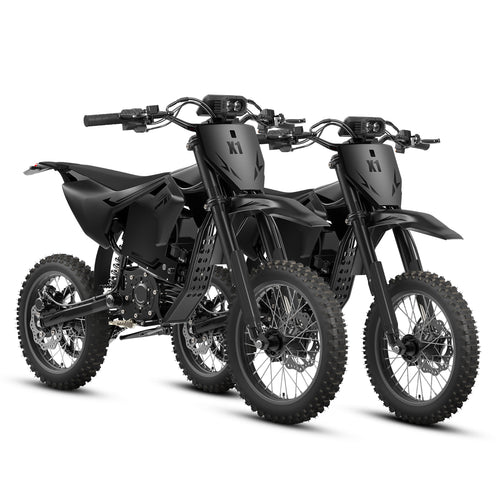
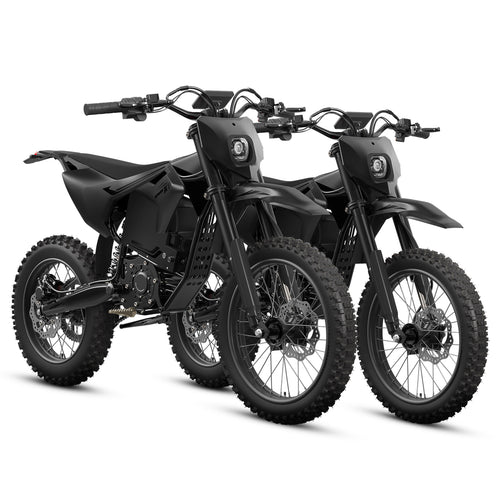
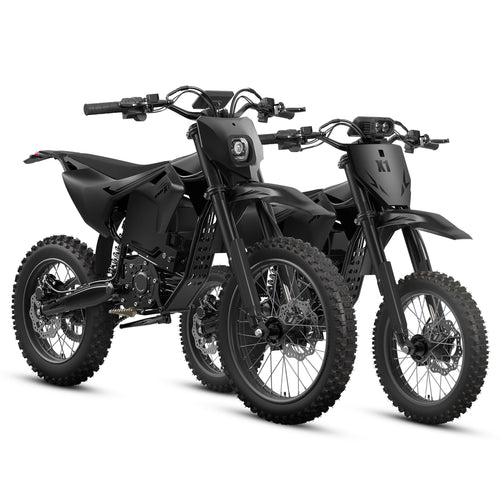
To better understand this kind of market-level difference, it helps to look at two representative configuration samples:
|
Reference Area |
A |
B |
|
Peak Power |
4500W |
6000W |
|
Top Speed |
50 mph |
65 mph |
|
Battery |
60V 28.8Ah |
60V 50Ah |
|
Max Range |
60 miles |
110 miles |
|
Torque |
283 N·m |
300 N·m |
|
Tire Setup |
17-inch front / 14-inch rear |
19-inch front / 17-inch rear |
These two examples are not meant to represent absolute market standards, but they do show one very real point: the difference between 4500W and 6000W peak models is usually not limited to a single area. It is often the result of multiple things changing together, including power, top speed, battery, range, and wheel setup.
In other words, when a 6000W bike feels clearly more complete, it is usually not because that extra 1500W is magically doing everything on its own. It is because a higher-power platform is often paired with a more complete overall package.
4500W vs 6000W: Which Electric Dirt Bike Is Better for You?
If what you care about most is a lighter, more direct riding feel and quicker control feedback, then a 4500W peak platform is usually already capable of delivering a very clear sense of performance. It is better suited for riders who value agility, easier control, and a more responsive overall feel.
If what you care about more is higher top speed, stronger power reserve, a larger battery setup, and a higher overall performance ceiling, then a 6000W peak platform will usually be the better fit. Its advantage is not only that it is faster, but that the full bike feels more complete in terms of speed, range, and sustained output.
📌 From that perspective, the real difference between a 4500W and 6000W electric dirt bike is not just the extra 1500W shown on the spec sheet. In most mainstream market products, these two peak power levels usually go on to create bigger differences in speed ceiling, power reserve, battery setup, range, and overall platform completeness.
🏁 What riders should really compare is not just the power number itself, but what kind of riding experience each power level ultimately leads to.
🔗 If you are still comparing different power platforms by speed, battery, and full-bike setup, it is worth looking at actual model configurations side by side. That usually makes it much easier to find the one that truly fits your riding style.
For riders also exploring the fastest electric dirt bikes, comparing real-world specs beyond peak power is often the best way to understand which platform actually matches their performance expectations.


